
No products in the cart.
Aviation Safety
Smarter Planning Makes Flying Safer

Ask anyone who has stood on a hangar floor at 2 a.m. waiting for a single part number, and they will tell you: an airplane is only as available as its slowest-moving spare. Behind every on-time departure sits an invisible relay race between Maintenance Planning, Materials, Procurement, Stores, Reliability, and Production Planning — and in 2026, that relay is being rewired by artificial intelligence, tighter OEM lead times, and a global spare-parts squeeze that shows no sign of easing.
The global MRO (Maintenance, Repair and Overhaul) market crossed roughly $84 billion in 2025 and is projected to climb toward $134.7 billion by 2034, growing at a 5.4% compound annual rate (Aerogility, 2025; OxMaint, 2026a). At the same time, more than 17,000 aircraft sit in a production backlog that will take over a decade to clear (Aerogility, 2025), and engine turnaround times have stretched from roughly 60–90 days in 2019 to 180–240 days today (ePlane AI, 2026a). In this environment, “smarter” is no longer a buzzword — it is survival.
To unpack what that actually looks like on the ground, we sat down with Dr. Deepak, a production planning and control leader with close to two decades of experience across MRO organizations, airlines, and aircraft maintenance operations. What follows is his interview, reorganized into a practical guide and cross-checked against current industry data — useful reading whether you are an aviation enthusiast trying to understand how an airline really runs, or a job seeker preparing for a Planning, Materials, or Supply Chain interview.
1. What Does “Smarter” Actually Mean for an Airline or MRO?
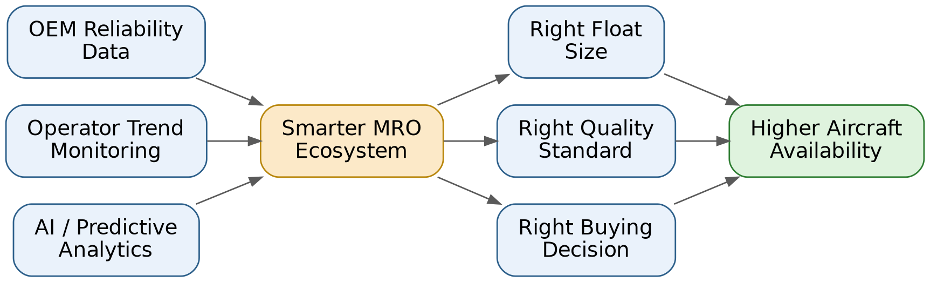
Dr. Deepak frames “smarter” as a whole-ecosystem upgrade — not a single tool, but process, people, and product moving together. In his words, original equipment manufacturers (OEMs) are now collaborating directly with operators to build reliability and durability statistics tailored to the actual operating environment, while operators lean on advanced trend monitoring to decide when to buy, what float size to hold, and what quality standard to demand.
The data backs this up. Predictive maintenance has moved out of pilot programs and into daily operations: platforms such as Airbus Skywise now pull data from more than 11,000 aircraft and can flag maintenance needs up to six months ahead of time (OxMaint, 2026a). Airlines running AI-driven diagnostics report 35–40% fewer unscheduled maintenance events and dispatch reliability above 99% (OxMaint, 2026a), while Deloitte’s research links predictive maintenance programs to a 15% cut in downtime and a 20% gain in labour productivity (Aerogility, 2025). “Smarter” spares and repairs, in other words, means converting historical failure data into a forward-looking float, repair, and sourcing strategy — before the part fails, not after.
2. When OEM Lead Times Stretch, Maintenance Planning Feels It First
A longer OEM lead time does not stay an OEM problem for long. As Dr. Deepak explains, planning professionals must respond by advising material planners to increase float size, or maintenance planning ends up absorbing non-staggered aircraft groundings — a scenario that ripples straight into flight operations.
This is precisely the pressure the industry is under right now. Engine shortages for next-generation GTF and LEAP engines have left around 60 completed Airbus aircraft grounded without engines, and over 3,500 commercial engines are waiting on castings and forgings (ePlane AI, 2026a). IATA estimates supply-chain-related costs will exceed $11 billion in 2025 alone, spanning higher maintenance costs, engine leasing, and additional inventory (ePlane AI, 2026b). Aviation regulators are advising operators to plan early with maintainers and suppliers, build regional stock buffers with OEMs, and pool spares with other operators where possible (Civil Aviation Safety Authority, 2026) — advice that echoes Dr. Deepak’s point almost exactly: float size is the shock absorber for lead-time volatility.
3. Becoming Smarter Instead of Reactive: Where to Start
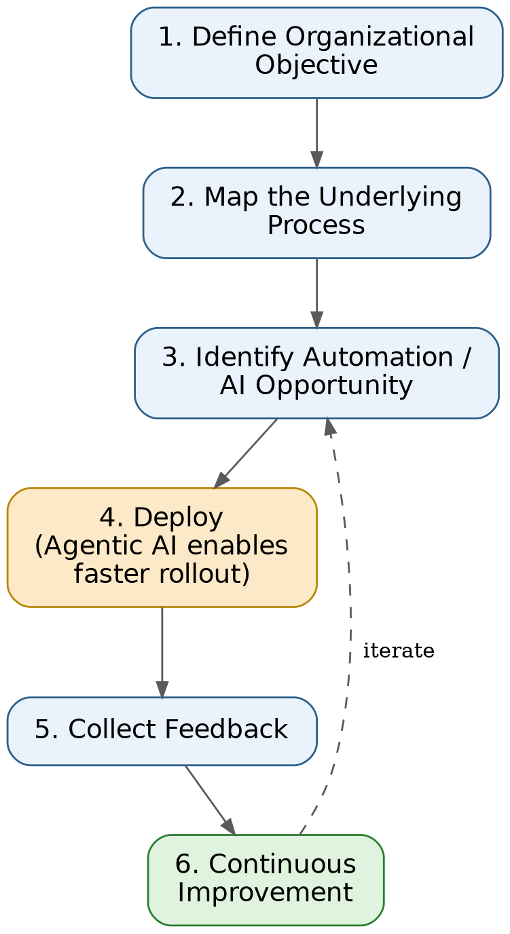
According to Dr. Deepak, the sequence matters:
- Clarify the organizational objective and map the processes that serve it.
- Identify where automation or AI genuinely adds value — not automation for its own sake.
- Iterate. Deploy, gather feedback, and improve continuously.
He specifically calls out Agentic AI as a technology that can now be deployed “much more quickly” than earlier generations of enterprise software — and 2026 industry commentary agrees. Agentic AI systems are described as moving beyond simple flagging of problems to autonomously initiating corrective actions — recommending gate swaps, re-sequencing, or turnaround prioritisation before a human even spots the pattern (International Airport Review, 2026). On the MRO and supply chain side, companies are piloting agentic tools for RFQ automation, supplier communication, and inventory demand prediction, explicitly to reduce AOG (Aircraft on Ground) exposure while improving part availability (ePlane AI, 2026c). One SAE technical paper released in 2026 documents a real-world agentic AI and “context engineering” solution built specifically to help MRO engineers diagnose AOG events, check regulatory compliance, and coordinate with OEMs faster across a fragmented ecosystem of disconnected systems (SAE International, 2026)
4. Repair, Replace, or Support Another Way? Building a Decision Framework
Dr. Deepak’s advice here is refreshingly quantifiable: weigh usable life and reliability data, market price, lead time, workshop support capability, and vendor warranties, then let those factors combine into an organization-specific, quantified decision criterion — rather than a case-by-case judgment call.
This matters more than ever given current market pressure. With emergency repairs costing roughly 4.8 times more than a planned maintenance event (ePlane AI, 2026a; OxMaint, 2026b), and with only around 6% of MROs currently using digital planning tools at scale (Aviation Awards Ireland, 2026), the organizations that formalize a repair-versus-replace scorecard are the ones capturing the competitive advantage that is still up for grabs. The rise of Used Serviceable Material (USM) as a supply strategy for legacy and out-of-production aircraft types is a direct market response to this same repair/replace/support calculation, trading a longer, variable lead time for cost efficiency on aging fleets.
| Factor | Question It Answers |
| Remaining useful life/reliability data | Will it fail again soon? |
| Market price | Is buying new/used cheaper than repair? |
| Lead time | Can the aircraft wait for this path? |
| Workshop/vendor capability | Is quality repair support even available? |
| Warranty terms | Does risk shift back to the vendor? |
5. Why Cross-Department Understanding Is a Career Asset, Not Just Nice-to-Have
This is where the interview becomes essential reading for job seekers.
Dr. Deepak is direct: anyone entering the industry — whether at an airline or an MRO — benefits from understanding how departments depend on each other and what each one is trying to achieve. He lists three concrete payoffs: a better career-progression strategy, stronger workplace collaboration, and more effective performance on the job.
He goes further on mobility: people with a maintenance or engineering background who build strong analytical and cross-functional understanding can move successfully into Planning, Materials, or Supply Chain, and in his experience, professionals with an aircraft maintenance background often become the strongest leaders in planning and supply chain management. Current hiring data supports this: airline and MRO supply chain job postings consistently ask for candidates with hands-on maintenance or engineering exposure alongside supply chain knowledge — for example, postings for aircraft materials planners and supply chain leads explicitly list aviation maintenance background, AOG support experience, and knowledge of vendor and warranty management as core requirements (Qatar Airways Careers, 2026; Virgin Atlantic Careers, 2025).
For Procurement specifically, Dr. Deepak stresses understanding the full downstream picture — shelf-life management, expiry dates, hydrostatic test dates, and scrapping criteria — as well as the upstream picture: the OEM’s Recommended Spare Parts List (RSPL), what is bundled into a new aircraft purchase package, and how statistical, network-wide collaboration among operators drives better pricing.
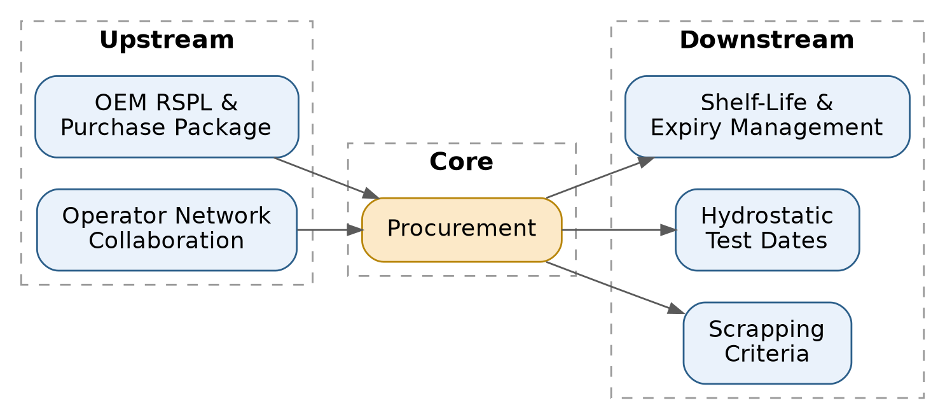
Career takeaway: in an interview for a Planning, Materials, Procurement, or Supply Chain role, be ready to explain how your target department connects to the two or three departments on either side of it. That single habit — thinking upstream and downstream — is what separates candidates who “know the job description” from candidates who understand the business.
6. The Hidden Cost of Poor Planning
Poor planning rarely shows up as a single line item — it shows up everywhere at once. Dr. Deepak’s answer maps a cascade: multiple aircraft grounded simultaneously creates a bottleneck that demands more manpower, more inventory, more hangar space, and more workload, which in turn raises the risk of human fatigue and safety lapses, and ultimately threatens an organization’s financial stability.
He also identifies urgent procurement, AOG logistics, excess inventory, and delayed repairs as the hidden downstream symptoms of weak planning — costs that rarely get traced back to their root cause. Current benchmarking supports the scale of this: an unplanned AOG event can cost an operator between $10,000 and $150,000 per hour (ePlane AI, 2026a), and in one modeled case, just 12 late parts on a 60-aircraft fleet’s C-check cycle stalled three simultaneous maintenance bays, costing roughly $185,000 per day in lost aircraft availability and passenger re-accommodation (OxMaint, 2026b). It is a vivid illustration of Dr. Deepak’s point: weak planning does not just cost more maintenance money — it manufactures entirely new categories of cost.
7. Where It All Starts: The Aircraft Maintenance Programme (AMP)
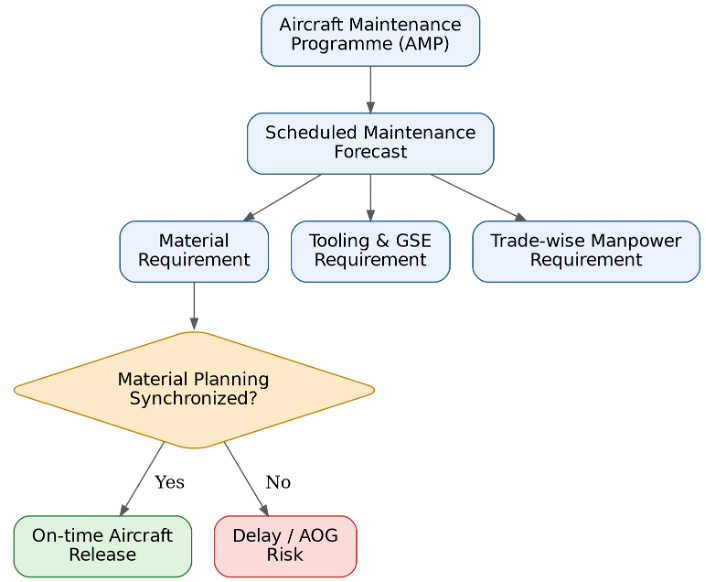
Dr. Deepak makes a case that everyone in Materials or Supply Chain — not just Maintenance Planners — should have at least a working understanding of the Aircraft Maintenance Programme (AMP). The AMP is the source document for scheduled maintenance forecasts, and each forecast task generates its own downstream requirements: materials, tools, Ground Support Equipment (GSE), and trade-specific manpower.
The trouble, he notes, is that even when the AMP forecast is accurate, the associated materials are sometimes not planned alongside it — a common industry failure point that increases turnaround time and can trigger AOG. If Maintenance Planning and Material Planning are not synchronized, the accuracy of the maintenance forecast becomes almost irrelevant, because the aircraft still cannot be released on time.
When multiple aircraft have checks landing in overlapping windows, Dr. Deepak recommends a staggered scheduling approach combined with critical path analysis — building in room for unplanned defects rather than scheduling every aircraft back-to-back with no slack.
8. From Plan to Execution: Maintenance Planning Meets Production Planning
Dr. Deepak draws a clean distinction: Maintenance Planning builds the work scope, while Production Planning finds the most efficient, optimized way to execute it — and the two must work in lockstep. He warns that even a well-built Gantt chart with critical path logic can absorb a delay of a few days on a minor item, but a long-lead critical part going missing can extend turnaround time significantly and trigger contractual penalties.
His conclusion is that Production Planning must stay in close, continuous communication with Material Planning, Procurement, and Stores throughout active maintenance — not just at the planning stage. This is exactly the coordination gap that current agentic AI pilots are targeting: tools now aim to give planners real-time visibility into inventory position, supplier lead time, and reorder triggers, aligned directly against the active work order (OxMaint, 2026b; ePlane AI, 2026c).
9. Reliability Data: The Bridge Between Reactive and Proactive Materials Management
The interview closes on a theme that ties everything together: reliability. When the Materials team understands reliability statistics — particularly Mean Time Between Failure (MTBF) and Unscheduled Removal Rate (URR) — stock levels can be prioritized around parts that actually fail more often, and reorder points can be adjusted proactively rather than reactively.
Dr. Deepak frames this as a three-way conversation: Reliability, Maintenance Planning, and Materials/Stores must stay synchronized so that the right stock is available before Production Planning needs it — closing the loop between forecasting and execution described earlier.

10. Career Corner: What This Means If You’re Job Hunting in Planning, Materials, or Supply Chain
Drawing directly from Dr. Deepak’s answers, three interview-ready themes stand out:
- Show you understand the ecosystem, not just your target role. Be ready to describe how Maintenance Planning, Material Planning, Procurement, Stores, Reliability, and Production Planning depend on each other — this single answer signals maturity beyond a job description.
- Speak in quantified terms. Whether discussing repair-versus-replace decisions or float sizing, reference reliability data, lead time, and cost — not just gut feel.
- Know your AMP basics. Even outside a Maintenance Planning role, being able to explain how a scheduled task generates material, tooling, and manpower requirements is a strong differentiator in Materials and Supply Chain interviews.
With global MRO demand still outpacing supply and roughly 68% of MRO leaders prioritizing AI adoption in 2026 (OxMaint, 2026b), organizations are actively hunting for professionals who can bridge maintenance know-how with data-driven planning and supply chain thinking — precisely the profile Dr. Deepak describes as the industry’s rising leadership pipeline.
Conclusion
“Smarter” spares, repairs, and inventory is not a single system you buy — it is a discipline that connects OEM data, reliability statistics, cross-department communication, and increasingly, AI and agentic automation, into one continuous feedback loop. As Dr. Deepak’s answers make clear, the aviation professionals who thrive in this environment are the ones who understand the whole chain, not just their own link in it.
References
- Aerogility. (2025, July 14). Aviation maintenance trends to watch in 2026. https://www.aerogility.com/?p=6310
- Aviation Awards Ireland. (2026). From reactive to ready: How AI-driven predictive maintenance is reshaping aviation’s costliest challenge. https://aviationawards.ie/news/from-reactive-to-ready-how-ai-driven-predictive-maintenance-is-reshaping-aviations-costliest-challenge
- Civil Aviation Safety Authority. (2026, April 24). Supply chain. https://www.casa.gov.au/node/424429
- ConRo Electronics. (2025, October 7). The future of aerospace maintenance: Innovation & reliability. https://www.conro.com/Blog/The-Future-of-Aerospace-Maintenance-Innovation-Reliability/
- ePlane AI. (2026a). Aircraft and engine shortages disrupt aviation supply chain. https://www.eplaneai.com/zh/news/aircraft-and-engine-shortages-disrupt-aviation-supply-chain
- ePlane AI. (2026b). How operational pressure drives airlines to adopt agentic AI. https://www.eplaneai.com/ja/news/how-operational-pressure-drives-airlines-to-adopt-agentic-ai
- ePlane AI. (2026c, February 2). ePlane AI at MRO Americas 2026: The future of maintenance, supply chain, and operational intelligence. https://www.eplaneai.com/blog/eplane-ai-at-MRO-americas-2026
- FL Technics. (2026, February 24). FL Technics CEO on the MRO trends that will define aviation in 2026. https://fltechnics.com/?p=221967
- International Airport Review. (2026). Agentic AI in airports: From assistive tools to autonomous airport orchestrators. https://www.internationalairportreview.com/agentic-ai-in-airports-from-assistive-tools-to-autonomous-airport-orchestrators/542296.article
- MANE. (2026). MRO industry predictions for 2026 and what it means for jobs and hiring. https://www.mane.co.uk/resources/blog/mro-industry-predictions-for-2026-and-what-it-means-for-jobs-and-hiring
- One Union Solutions. (2026). Aircraft spare parts shortage in 2026: How aviation supply chains are struggling and adapting. https://oneunionsolutions.com/blog/aircraft-spare-parts-shortage-in-2026-how-aviation-supply-chains-are-struggling-and-adapting/
- OxMaint. (2026a). Aviation maintenance trends & technologies 2026. https://oxmaint.com/industries/aviation-management/aviation-maintenance-trends-technologies-2026
- OxMaint. (2026b). Top 10 AI use cases transforming aviation MRO in 2026. https://oxmaint.com/industries/aviation-management/top-ai-use-cases-aviation-mro-2026
- OxMaint. (2026c). Aviation spare parts lead time scheduling: CMMS guide 2026. https://oxmaint.com/industries/aviation-management/aviation-spare-parts-lead-time-scheduling-cmms-guide
- Qatar Airways Careers. (2026). Supply chain lead (aviation) [Job posting]. https://careers.qatarairways.com/global/JobDetail/Supply-Chain-Lead-Aviation/28406
- Research and Markets. (2026). Aviation MRO market report. https://www.researchandmarkets.com/reports/5793054/aviation-mro-market-report
- SAE International. (2026). Transforming aircraft MRO with agentic AI and context engineering (Technical Paper No. 2026-26-0788). https://saemobilus.sae.org/papers/transforming-aircraft-mro-agentic-ai-context-engineering-2026-26-0788
- Virgin Atlantic Careers. (2025, August 2). Planner – supply chain component maintenance and warranty [Job posting]. https://careers.virginatlantic.com/search-and-apply/planner-supply-chain-component-maintenance-and-warranty-2929