
No products in the cart.
CAR
CAR-145 Shaping Airlines and MRO organizations in Aviation Industry
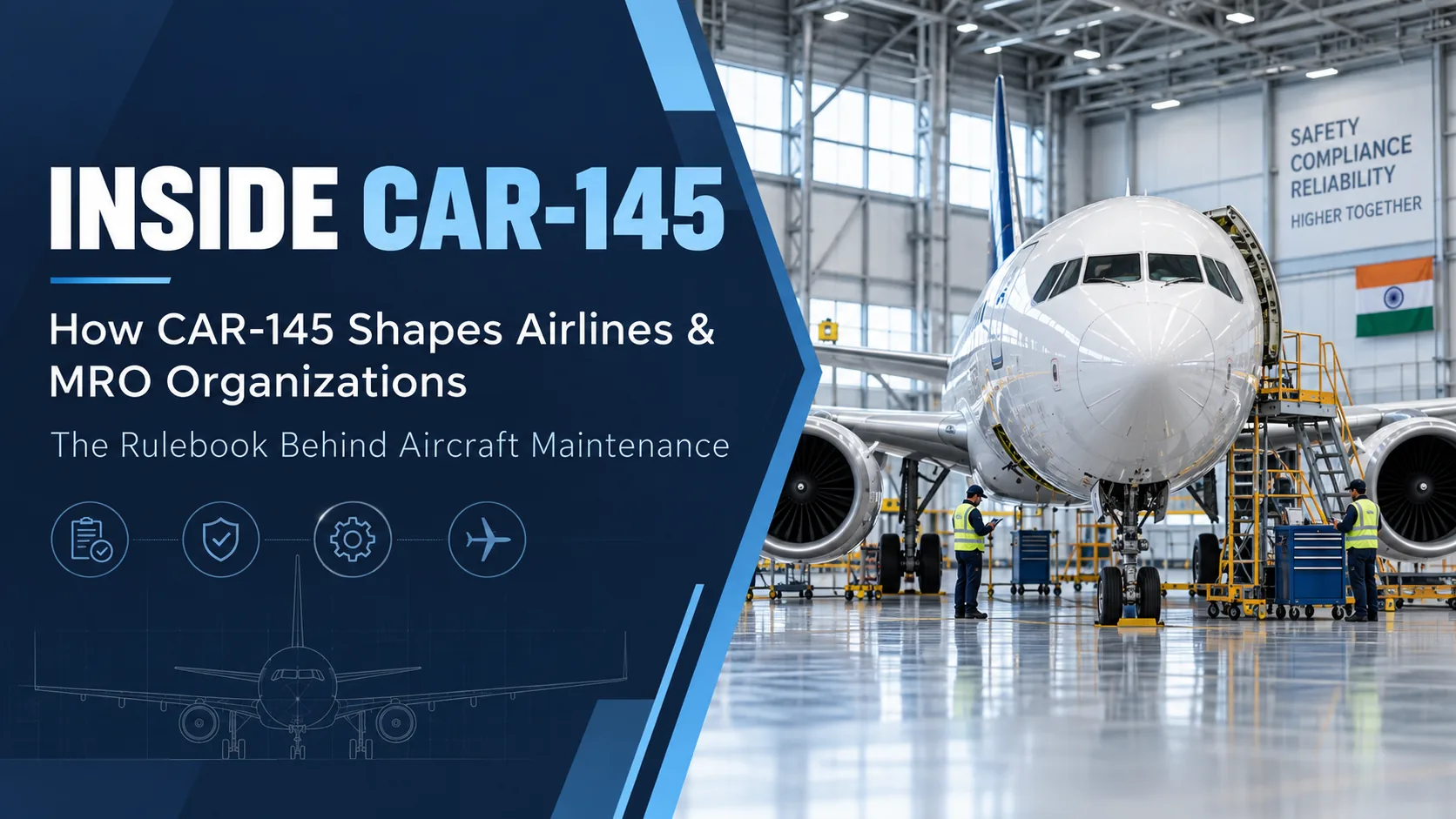
I’ve spent enough years around hangars, audit files, and DGCA correspondence to know one thing for certain: nobody falls in love with a regulation. You respect it. You work around its edges. On a good day, you forget it’s even there because the systems it built are humming quietly in the background. CAR-145 is exactly that kind of regulation — invisible when it’s working, and the first document everyone reaches for the moment it isn’t.
If you’ve spent any time in an MRO, a line station, or an airline engineering department in India, you’ve lived inside CAR-145 whether you realised it or not. This post is my attempt to explain it the way I wish someone had explained it to me early on — not as a wall of clauses, but as a living framework that shapes how Indian aviation actually gets aircraft back in the air, safely, every single day.
1. What Exactly Is CAR-145?
CAR-145 is the Civil Aviation Requirement issued by India’s Directorate General of Civil Aviation (DGCA) that governs the approval of Maintenance Organisations — the MROs, airline engineering bases, and line stations that maintain aircraft and components used in commercial air transport and complex aircraft.
It isn’t a voluntary code of good practice. It’s issued under Rule 133A of the Aircraft Rules, 1937, and any organisation that wants to maintain aircraft or components commercially in India has to hold an approval under Rule 133B first. First issued back in 2005 and modelled closely on European JAR-145/EASA Part-145 standards, CAR-145 has been revised repeatedly to stay in step with international practice, most recently with Issue 3, which came into effect on 1 January 2025.
Strip away the legal language and CAR-145 answers a fairly simple question: what does an organisation have to prove — about its people, its facilities, its procedures, and its culture — before DGCA will trust it to sign off that an aircraft is fit to fly again after maintenance? Everything else in the regulation, from personnel licensing requirements to record retention periods, exists to answer that one question in more and more detail.
2. Why CAR-145 Actually Matters?
It’s tempting to file CAR-145 under “compliance paperwork,” but that undersells it badly. Every Certificate of Release to Service issued in this country rests on the scaffolding CAR-145 puts in place. Take away that scaffolding and you don’t just lose paperwork discipline — you lose the chain of accountability that lets an airline, a regulator, and eventually a passenger trust that a wrench turned correctly and someone independent checked the work.
That matters more in India right now than it has in a long time. The domestic commercial fleet has grown from a few hundred aircraft a decade ago toward the thousand-plus mark today, and the country is already among the three largest aviation markets in the world by passenger volume. Industry forecasts put India’s MRO spend on a path to roughly double over the next decade, and recent analysis has flagged India as one of the fastest-growing maintenance markets globally, driven by an ageing global fleet, delivery backlogs at the OEMs, and rising utilization. None of that growth is sustainable without a maintenance oversight framework that scales with it. That framework is CAR-145.
There’s also a quieter, more personal reason it matters: it protects the people doing the work. The “Just Culture” principle baked into CAR-145 — where honest errors are treated as learning opportunities rather than disciplinary events, while negligence and wilful violations are not tolerated — exists because organisations that punish every mistake stop hearing about the ones that matter. That single idea has probably prevented more incidents than any single technical clause in the regulation.
3. Where CAR-145 Actually Bites: The Areas It Touches?
CAR-145’s reach is wider than people expect. Once you’ve worked inside it for a while, you start noticing its fingerprints everywhere:
3.1 Facilities and equipment
From segregated serviceable/unserviceable storage to calibrated tooling, the physical environment has to match the scope of work being approved.
3.2 Personnel structure
The Accountable Manager, nominated post-holders for maintenance, compliance monitoring and safety management, and the certifying staff who physically sign off the work. This is the backbone the rest of the regulation hangs off.
3.3 Production planning
Man-hour planning, shift design, fatigue-aware rostering, and handover discipline. This is where planning meets the shop floor, and where a lot of real-world compliance either holds up or quietly falls apart.
3.4 Facilities and equipment
How a part is classified, accepted, stored, and released. All these transactions are accompanied by an authorized release certificate such as CA Form 1 or equivalent EASA Form 1, FAA Form 8130-3, and other similar documents which prove the item’s authenticity.
3.5 Records and reporting
Retention periods for maintenance records, and a mandatory occurrence-reporting system that feeds straight into safety management.
3.6 The Management System itself
New version of CAR-145 explicitly accommodates the ICAO Annex 19 Safety Management System framework, not just a quality manual.
If your work touches any of those areas — planning, stores, certifying staff management, vendor coordination, or safety — you’re already operating inside CAR-145’s boundaries, whether your job title mentions “regulatory” or not.
4. How CAR-145 Is Evolving?
This is the part longtime engineers sometimes miss, because regulations that have been around for two decades start to feel fixed. CAR-145 isn’t fixed. Issue 3 was the biggest structural shift the regulation has seen since its original release — it retired the old “Quality System” language entirely and replaced it with a full Management System built around the four ICAO SMS pillars: safety policy, safety risk management, safety assurance, and safety promotion.
That’s not a wording change. It’s a mental model change. A Quality System looks backward — did we do what the manual said? A Safety Management System looks forward — where are the hazards we haven’t found yet, and how do we know our fixes actually worked? Organisations that are still running their compliance function like a Quality System in 2026 are, functionally, running an outdated operating system on modern hardware.
The transition window for existing Issue 2 organisations to demonstrate Issue 3 compliance ran through mid-2026, which places most of the Indian MRO industry right in the middle of this shift as of this year. It’s also worth noting this isn’t happening in isolation — regulators elsewhere have been moving in the same direction in the same window, with UK CAA’s Part-145 organisations facing their own SMS implementation deadline this year too. CAR-145 evolving in lockstep with EASA Part-145 and the wider ICAO framework isn’t a coincidence; it’s the regulation doing exactly what it’s designed to do, which is keep India’s maintenance standards interoperable with the rest of the world’s.
5. How CAR-145 Ripples Through the Aviation Industry?
Here’s where it gets practical. India is trying to do something ambitious: grow from a country that outsources a large majority of its heavy maintenance work abroad into a genuine MRO hub in its own right. Government policy has been leaning hard into that goal — full foreign direct investment in MRO services, a simplified uniform tax rate on imported maintenance parts and tooling, and sustained investment in aviation-specific training infrastructure.
None of that investment means anything without a regulatory framework that international lessors, OEMs, and airlines actually trust. CAR-145 is that trust mechanism. When it’s harmonised with EASA Part-145, when its forms are recognised alongside EASA Form 1 and FAA 8130-3, and when its Management System speaks the same ICAO SMS language as everyone else’s, it lowers the friction for global players to route work into Indian MROs instead of Singapore, the UAE, or Sri Lanka — where a large share of Indian MRO work has historically gone.
At the operational level, the ripple effects show up in very concrete ways: airlines and MROs restructuring their compliance monitoring functions to be genuinely independent of production, planning teams building fatigue-awareness into shift rosters for the first time as a documented requirement rather than a courtesy, and stores teams tightening up segregation practices because it’s one of the most commonly cited findings in audits. It also shows up in contracts — the distinction between “contracting” and “subcontracting” under CAR-145 directly affects how vendor agreements get written and who ultimately carries certification responsibility.
6. How Professionals Can Actually Benefit From Understanding CAR-145?
This is the piece I care about most, because I’ve watched two very different types of engineers move through their careers. One type treats CAR-145 as something the quality department worries about. The other treats it as a map of exactly what the industry rewards.
If you’re serious about your career in Indian aviation maintenance, here’s where fluency in CAR-145 pays off directly:
6.1 Certifying staff and engineers
Those who understand the recency and recurrent training requirements under 145.A.35 protect their own authorization status instead of discovering a lapse during an audit.
6.2 Planners and PPC professionals
Who understand 145.A.47 and 145.A.48 in depth become the people who can defend a staffing decision or a schedule change with the regulation, not just a gut feeling — that’s a genuinely rare and valued skill.
6.3 Quality and compliance monitoring staff
Those who understand the Level 1 versus Level 2 finding framework can triage real issues faster and stop minor process gaps from being escalated (or worse, genuine safety issues from being minimized).
6.4 Anyone eyeing a post-holder role
Needs CAR-145 fluency as a baseline; the credentials submitted on CA Form 4 aren’t a formality, they’re DGCA’s evidence that you actually understand the job you’re being nominated for.
6.5 Professionals who want portability
Understanding how CAR-145 maps onto EASA Part-145 and ICAO Annex 19 makes your knowledge transferable if your career ever takes you outside India, because you’re not just learning a local rulebook; you’re learning the global grammar of aviation maintenance regulation.
In an industry where India’s MRO sector is being talked about as one of the fastest-growing in the world, the professionals who understand the regulatory backbone early are the ones who end up running the compliance functions, leading the audits, and sitting in the room when an organisation decides how to scale. CAR-145 fluency isn’t a defensive skill. It’s a career accelerator.
7. The Bottom Line
CAR-145 will never be exciting reading. But it’s one of the more quietly important documents in Indian aviation — the reason a released aircraft can be trusted, the reason a growing MRO industry has a shot at global credibility, and the reason the people doing the actual wrench-turning have a system that backs them up instead of hanging them out to dry. Understanding it properly isn’t about ticking a training box. It’s about understanding the industry you’ve chosen to build a career in.
*If you’re looking to build that understanding properly — module by module, from the regulatory foundations through to the modern Safety Management System — that’s exactly what our CAR-145 training programme is built to do. Get in touch to find out more.
The skies are only as safe as the people working within the aviation ecosystem are well versed in CAR-145 regulations, which makes them champions every single day.
References
Primary Regulatory Sources
- DGCA — Civil Aviation Requirements, CAR-145 (Approval of Maintenance Organisations), Directorate General of Civil Aviation, Government of India — the regulation itself. https://www.dgca.gov.in/digigov-portal/?baseLocale=en_US?dynamicPage=dynamicPdf/UxsD1T3rGBtO9Qtacfhs2Q%3D%3D&maincivilAviationRequirements/6/0/viewDynamicRulesReq
- Aircraft Rules, 1937 — Rule 133A and Rule 133B, Ministry of Civil Aviation, Government of India
Industry / Market Data Sources
- Oliver Wyman, Global Fleet & MRO Market Forecast 2026–2036 — cited via Aviation Jeta, “India MRO Market Set For Fastest Global Growth” (May 2026): https://aviationjeta.com/india-mro-market-fastest-global-growth/
- Deloitte India, MRO in India — Poised to Take Off: https://www.deloitte.com/in/en/Industries/energy/research/MRO-in-India-Poised-to-take-off.html
- IBEF (India Brand Equity Foundation), The Future of the MRO Industry in India: https://www.ibef.org/blogs/the-future-of-the-mro-industry-in-india-trends-and-opportunities
- UJA Market Report, MRO Industry in India: https://uja.in/blog/market-reports/mro-industry-in-india/
- Business Standard, DGCA releases regulatory reforms to reduce compliance burden for operators: https://www.business-standard.com/industry/news/dgca-releases-regulatory-reforms-to-reduce-compliance-burden-for-operators-124090300746_1.html
Comparative/Global Regulatory Context
- AeroSupport360, UK CAA Part-145 SMS Implementation (parallel global SMS deadline, July 2026): https://aerosupport360.com/uk-caa-part-145-sms-implementation-1-july-2026-deadline/