
No products in the cart.
Uncategorized
Significance of Project Planning in Aircraft Maintenance Execution:Why Every On-Time Departure Starts in the Planning Office

Every aircraft that pushes back on schedule has a quiet story behind it, and most of that story is written long before the first panel is opened. It is written in the planning office, in work packages, resource plans, risk registers and hangar slot calendars. If you work in aircraft maintenance, MRO, airline engineering or aviation training, you already feel it: project planning is the backbone of aircraft maintenance execution.
In this article, we look at why planning matters so much, what the world’s hardest lessons have taught us, and how today’s planners are handling record demand, supply chain pressure and fast-moving technology.
The hidden engine behind every on-time departure
Aviation is growing, and maintenance is growing with it. Oliver Wyman Vector’s 2026 forecast puts the
global commercial fleet at about 30,000 aircraft in 2026, rising to about 41,000 by 2036, a 3.2%
compound annual growth rate. The global MRO (maintenance, repair and overhaul) market is estimated at around $139.6 billion, growing at about 3.3% a year, with India showing the fastest fleet and MRO growth among the regions mapped (Oliver Wyman Vector, 2026).
More aircraft means more heavy checks, more engine shop visits, more cabin retrofits and more
pressure on hangar slots. In that world, a delay of a few days on a single aircraft is not a small thing. It
means lost revenue, disrupted schedules and unhappy customers. That is why modern MRO
organizations treat every major maintenance event as a project, with a start, an end, a budget and a
promised turnaround time (TAT).
What is aircraft maintenance project planning?
A heavy check, a C-check, a landing gear overhaul, an engine change or an end-of-lease redelivery can involve hundreds or thousands of task cards, many licensed engineers, specialist tooling, spares from several continents and a customer waiting for the aircraft back. Approved maintenance organizations under frameworks such as EASA Part-145 must plan and control this work in a disciplined, traceable way (European Commission, 2014), and the same expectation runs through the FAA, DGCA and GCAA systems.
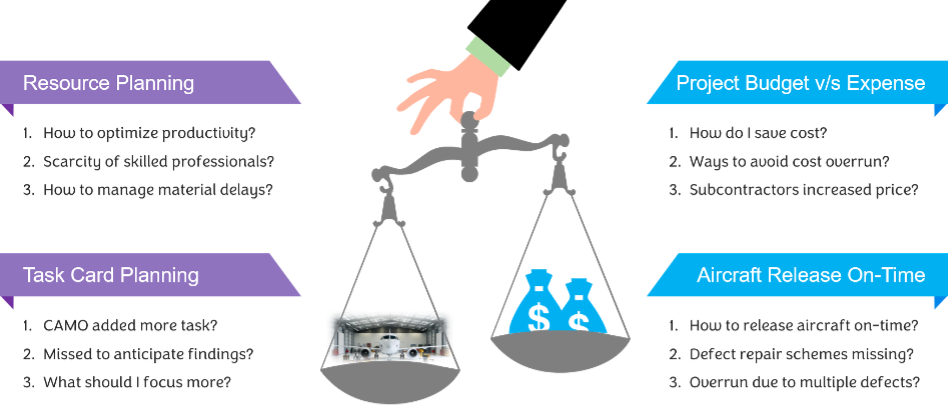
In practice, good project planning rests on four key pillars:
- Work Scope: defining the work package from scheduled checks, deferred defects, airworthiness directives and customer requests, then tracking it to completion.
- Resource: planning engineers, certifying staff, materials, tooling, ground support equipment and hangar space.
- Budget and Risk: estimating cost, funding contingency and asking, “What could go wrong, and what would it cost us?”
- Control and Reports: monitoring progress, managing records and keeping the customer informed with transparent reporting.
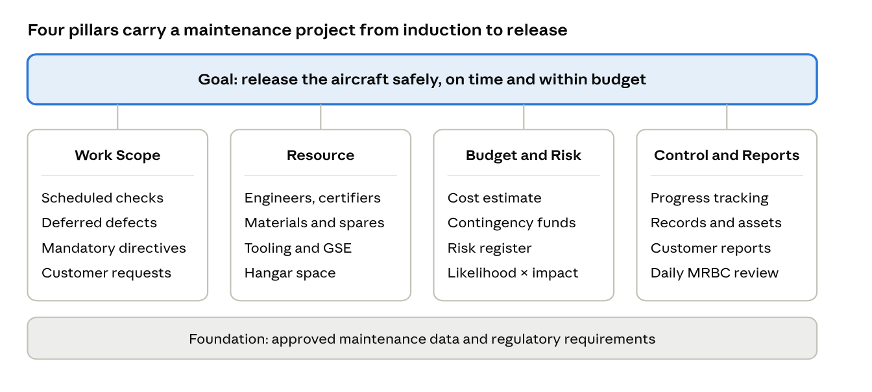
Think of these as the four legs of a table. Remove one, and the whole project becomes unstable.
Lessons written in hard experience: four examples from around the world
The best argument for planning discipline comes from what happens when it falls short, and from what the industry did next. These cases are studied in maintenance organisations worldwide, and we share them with respect for everyone affected.
- Aloha Airlines Flight 243, United States (1988).
On 28 April 1988, a Boeing 737-200 suffered explosive decompression at 24,000 feet when about 18 feet of cabin skin and structure separated in flight. One flight attendant was lost, and the crew landed the aircraft at Kahului, Maui. The National Transportation Safety Board examined the quality of the airline’s maintenance programme, regulatory oversight, and multiple-site fatigue cracking in the fuselage lap joints (National Transportation Safety Board [NTSB], 1989). Planning lesson: an ageing aircraft needs an inspection programme that is planned, tracked and supervised, not just assumed.
- Alaska Airlines Flight 261, United States (2000).
On 31 January 2000, an MD-83 was lost in the Pacific Ocean with all 88 people on board. The NTSB found that excessive wear from insufficient lubrication caused the failure of the horizontal stabiliser trim jackscrew assembly’s acme nut threads. It also identified the airline’s extended lubrication interval and extended end-play check interval, together with regulatory approval of those extensions, as contributing factors (NTSB, 2003). Planning lesson: every change to a task interval needs strong engineering justification, risk assessment and the right approvals, because the planner carries that decision into every future work scope.
- British Airways Flight 5390, United Kingdom (1990).
On 10 June 1990, a BAC One-Eleven lost its left cockpit windscreen in flight. The windscreen had been replaced the night before, and 84 of the 90 securing bolts were smaller than the specified diameter. The Air Accidents Investigation Branch found that a safety-critical task had been done by one individual who carried total responsibility for the quality achieved, and that the task had not been identified as a vital point requiring independent inspection. The captain survived, and the crew landed safely (Air Accidents Investigation Branch [AAIB], 1992). Planning lesson: independent checks, handovers and shift planning belong in the plan, not in the margins.
- Qantas Flight QF32, Australia and Singapore (2010).
On 4 November 2010, an Airbus A380 suffered an uncontained engine rotor failure shortly after departing Singapore. The Australian Transport Safety Bureau traced the event to an oil feed stub pipe in the Rolls-Royce Trent 900 engine that had been manufactured with a thin wall section, leading to a fatigue crack and an internal oil fire. Afterwards, the manufacturer, regulators and A380 operators worked to identify affected engine assemblies and either remove them from service or manage them for safe continued operation (Australian Transport Safety Bureau [ATSB], 2013). Planning lesson: when a fleet-wide issue appears, operators and MROs suddenly run an unplanned project, and the teams with clear scope, resources and stakeholder communication recover fastest.
Today’s pressure test: engines, AOG and supply chains
A modern example is unfolding right now. Since 2023, Pratt & Whitney’s PW1000G geared turbofan fleet has been working through a large inspection programme linked to a powder metal condition in certain engine parts. Aviation Week reported in October 2025 that the programme was more than two years into an expected three-year surge, that Pratt’s guidance pointed to about 350 aircraft on the ground (AOG) on average through the end of 2026, and that around 720 PW1000G-powered aircraft, roughly 30% of the in-service fleet, had been on the ground for at least 30 days as of 20 October 2025. The same report noted that MRO output was the key to bringing AOG levels down (Broderick & Williams, 2025).
For airlines in Europe, Asia, the Middle East and the Americas, this is project planning at global scale: forecasting shop visit slots, securing spare engines, adjusting schedules and managing customer expectations. Operators with realistic buffers and early plans fare better than those who react late.
The lesson is simple. Supply chain constraints, workforce limits and engine shop capacity cannot be wished away, but they can be planned around.
The planner’s toolkit
A strong planner does not rely on instinct. They use proven tools, many of which are also at the heart of mainstream project management practice (Project Management Institute [PMI], 2021):
- Work Breakdown Structure (WBS): breaks the visit into trackable work packages by zone, system or trade, so nothing is forgotten.
- Task card grouping: groups cards by access panel, zone, maintenance type and skill code, so a panel is opened once and closed once.
- Critical path analysis: shows the chain of tasks that decides the minimum grounding time. Delay one task on that path, and the release date moves with it.
- Gantt chart and milestones: makes the plan visible to everyone, from the hangar floor to the customer.
- Risk register: scores each risk by likelihood and impact so the team focuses first on what matters most.
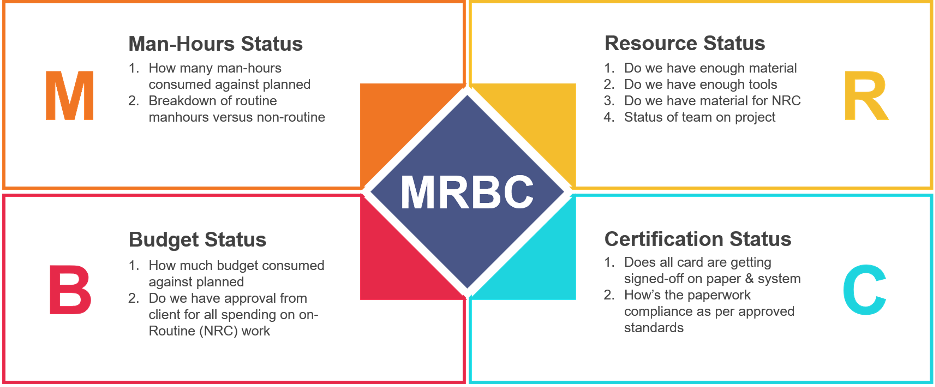
- MRBC review: a daily check of Man-hours, Resources, Budget and Certification status.
- Earned value management (EVM): uses planned value, earned value and actual cost to calculate indices such as SPI and CPI. A value below 1.0 signals behind schedule or over cost.
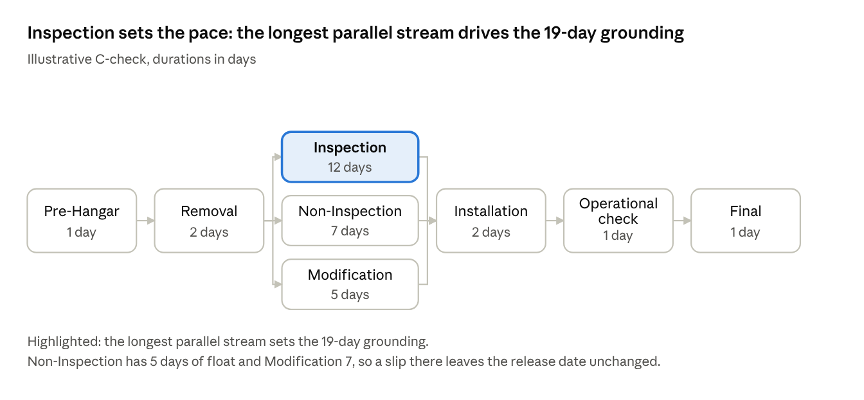
In this illustrative C-check, the Inspection stream is the longest of the three parallel streams, so a lost day there is a lost day for the whole project.
Here is a simple, illustrative example. If a C-check has a planned value of 10,000 man-hours, an earned value of 9,000 and an actual cost of 9,500, the schedule performance index is 0.90 and the cost performance index is about 0.95. Both are below 1.0, and the planner knows it early enough to act, perhaps by moving engineers from a stream with float to the critical inspection stream.
Smart planning in the age of digital MRO
Predictive maintenance, AI-assisted analytics, digital task cards, real-time hangar dashboards and digital twins are all on the agenda of MRO leaders today. They are powerful, but they work best on top of good planning fundamentals. A predictive alert is only useful if there is a hangar slot, a skilled engineer, the right part and a clear approval route to act on it. Technology amplifies a good plan. It cannot replace one.
Five takeaways for aircraft maintenance planners
- Define the scope first. Get the work package right before the aircraft arrives.
- Plan resources, not just tasks. People, parts, tools, GSE and hangar space all need to be in the right place at the right time.
- Fund the unexpected. Build contingency and a risk register into the budget.
- Protect the critical path. Put your best effort where a lost day is a lost day for the whole project.
- Make progress visible every day. Dashboards, Gantt charts and daily MRBC reviews let you act while a slip is still small.
Final thoughts
Behind every safe, on-time aircraft release is a plan, and behind every plan is a planner who cared enough to get it right. Whether you work in a hangar in Singapore, Dubai, Frankfurt, Atlanta or India, you are part of that backbone.
Want to build these skills step by step? Explore our aviation training programmes at www.ipint.org.